About the Society

A scientific society for the brain–mind domain

The Cognitive Neuroscience Society of India (CNSI) brings together the clinicians, academicians and technologists who study, research and practise in the brain–mind areas — so that the understanding emerging from each discipline can inform all the others.

Our story

Founded at NIMHANS, built across India

CNSI grew out of a shared conviction among neuroscientists, clinical psychologists, neurologists, psychiatrists and engineers that the brain and the mind can only be understood together — through integrated, multidisciplinary work. Led by Prof. C.R. Mukundan, who established clinical neuropsychology and cognitive electrophysiology at NIMHANS, the founding group registered the Society in Bengaluru under the Karnataka Societies Registration Act, 1960.

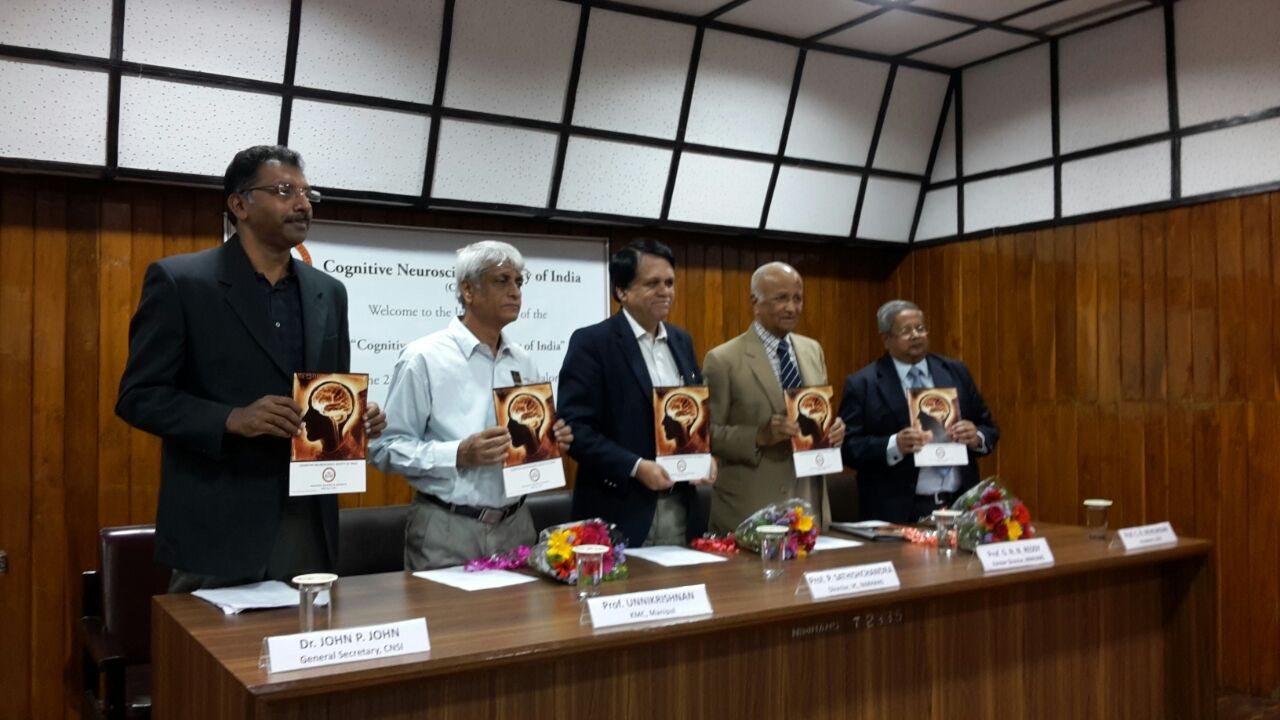
The Society was inaugurated on 21 June 2015 at NIMHANS by Prof. P. Satishchandra, Director and Vice-Chancellor, with an inaugural souvenir released by Prof. G.N.N. Reddy. Its eighteen founding committee members came from NIMHANS, Kasturba Medical College Manipal, the Gujarat Forensic Sciences University, Banaras Hindu University, AIIMS New Delhi, NIMS Hyderabad, Nitte University and Axxonet.
Since then CNSI has held its first National Conference at GFSU, Gandhinagar (April 2016), run the Cognitive Confluence lecture and workshop series with the Department of Neurophysiology at NIMHANS, and convened the CNSI-2020 International Conference on Forensic and Clinical Applications of Cognitive Neuroscience. Prof. Bindu M. Kutty leads the Society as President, with Prof. Mukundan continuing as Honorary President.

Release of the inaugural souvenir at NIMHANS on 21 June 2015
Inaugural meeting, NIMHANS, 21 June 2015 — Dr John P. John, Prof. Unnikrishnan M., Prof. P. Satishchandra, Prof. G.N.N. Reddy and Prof. C.R. Mukundan release the souvenir.

Objectives

What the Memorandum of the Society sets out to promote

  1. 01Understanding the neurocognitive changes and deficits produced by brain lesions, and by pharmacological, structural and functional interventions in the brain.
  2. 02Neurocognitive technology development, neuroelectronics and neurocomputing models of neurocognitive functions.
  3. 03Development and application of neurocognitive enhancement programmes.
  4. 04Study of the origins of criminal behaviour and the effects of social conditioning on the neurobiological development of behavioural control — forensic neuropsychology.
  5. 05Promotion and support of training in clinical, academic and research work in neurorehabilitation, neuropsychology and cognitive neuroscience.
  6. 06Disseminating knowledge to professionals, students, teachers and the public through workshops, seminars and public lectures.
  7. 07Partial travel grants for students of neuroscience, neuropsychology and neurocognition to attend national and international conferences; yearly Society and Core Group meetings.

Disciplines

Where the understanding comes from

Cognitive processes — signal acquisition and analysis, signal-to-information conversion, semantic interpretation, emotional states and their cognitive evaluation — are studied from many professional specialities.

Neurophysiology Neurology Neurosurgery Neuropsychology Neuropsychiatry Forensic neuropsychology Psychopharmacology Psychophysiology Language & speech Cognitive electrophysiology Neurocomputing Movement & music therapies Meditation & hypnosis Sleep & wakefulness

Core Interest Groups

Specialist groups members can join

Each Core Interest Group has a Chairperson appointed by the Executive Committee. A member may join more than one group.

  • Clinical neuropsychology
  • Geriatric neuropsychology
  • Neuropsychological rehabilitation
  • Training for learning-disabled children and autism
  • Brain resource development for excellence in cognitive performance
  • Sleep and awareness
  • Meditation and its effects on brain and mind
  • Hypnosis as a neurocognitive intervention
  • Methods: functional neuroimaging and cognitive electrophysiology

Governance & registration

How the Society is run

Executive Committee

Elected once in two years by the Primary Members. The President, General Secretary and Treasurer serve two-year terms; editors serve three. The EC meets at least twice a year.

General Body

An Annual General Meeting is held each calendar year to approve accounts, receive officers' reports and present the budget. Each member has one vote.

Registration

Registered in 2015 under the Karnataka Societies Registration Act, 1960 (Karnataka Act 17 of 1960). Registration No. JNR S474-2014-15/JNRS21. Financial year 1 April – 31 March.

Documents

The Memorandum and Bye-laws set out membership, office-bearer responsibilities, Core Interest Groups and the planned Indian Journal of Cognitive Neuroscience.

Resources & downloads